

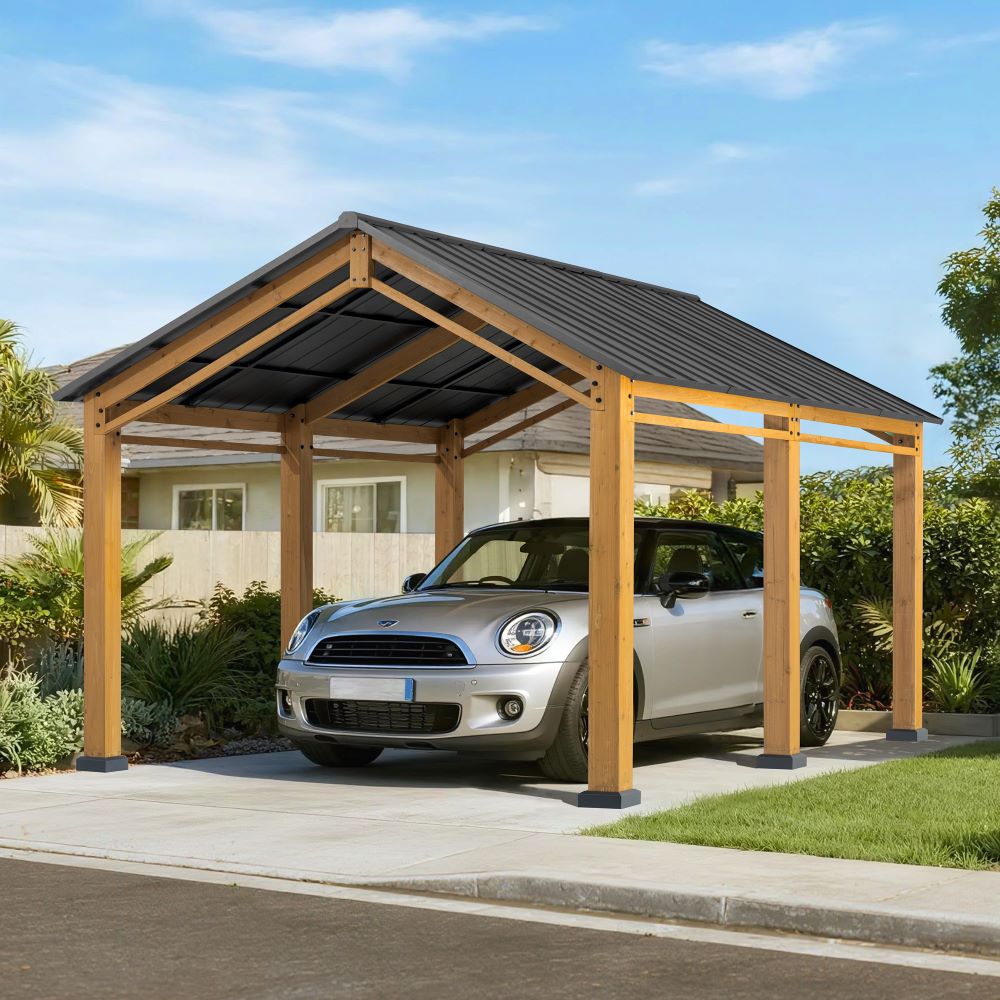
Where Sunjoy Carports fits: think through car-door access and walk-around room for RV or trailer storage
Families comparing SUNJOY carports should start with movement, not just the vehicle footprint. A covered space must leave room for people to open doors, carry supplies, walk around a trailer, and use the surrounding yard without creating an awkward route. The right planning question is not simply, “Will the vehicle fit?” It is, “Can the family use the space comfortably after it is installed?”

Frame the outdoor-space problem
Car-door access can change how a carport works from one day to the next. A vehicle may fit beneath a roof while the nearest door opens toward a fence, garden bed, wall, or stored item. That can turn a basic parking task into repeated shuffling. Families who host outdoors should also consider the route from the vehicle to the patio, grill, table, or house.
- Define whether the space is intended for a vehicle, RV, trailer, equipment, workspace, shaded patio, or storage use.
- Record the selected model’s stated dimensions, materials, configuration, and included components separately from your site-planning assumptions.
- Map car-door access, side access, walking routes, and the movement needed around the stored vehicle.
For RV or trailer storage, the walking pattern may be less obvious. People may need access near steps, storage compartments, a hitch, or a side door. These are planning prompts rather than claims about any particular model. Sketch the vehicle, the intended walking paths, and the objects that must pass through the space. Then look for pinch points before comparing product details.
Match the category to the intended use
The SUNJOY collection page discusses carports for vehicles, RVs, or equipment. It also presents possible uses such as an outdoor workspace, shaded patio, or storage area. That range makes the intended use important. A family protecting a regularly used car may value clear door access and a short route to the house. Someone storing an RV or trailer may give more attention to side access, loading movement, and the space needed to walk around the unit.
When browsing carports for sale, separate the use case from the label on the collection page. “For RVs” or “for equipment” can help a shopper identify a relevant category, but it does not by itself establish that every model suits every vehicle or layout. Treat the collection as a starting point. For the selected model, compare the listed dimensions and configuration with the actual vehicle, trailer, and site plan.
It also helps to consider what happens around the covered space. A carport may sit beside a path, planting area, outdoor dining zone, or storage location. Door clearance is only one part of the experience. Walk-around room can affect whether people can reach the far side, load items, sweep the area, or move between the vehicle and the rest of the yard.
Use page-listed details without overextending them
The collection describes steel frames and weather-resistant roofing as features of its metal carports. Those are page-listed material claims. They can help a shopper understand the category, but they do not answer every site-planning question. A material description does not establish how a specific model will fit beside a boundary, how much usable clearance remains, or how an installation will interact with an existing surface.
A useful comparison has two columns in your notes. In the first, record what the selected product page actually lists: dimensions, included components, stated materials, and any named configuration. In the second, record the practical questions created by your site: Can both commonly used doors open? Is there a continuous walking route? Can people reach the trailer or RV side access? Does the planned position preserve the route to the house? This keeps confirmed details separate from household assumptions.
Start with the kit, then ask model-specific questions
The SUNJOY carport collection describes its kits as including pre-cut parts, hardware, and step-by-step instructions. That is a useful real-world anchor for the shopping process: the kit is presented as a package intended to organise the parts and assembly information, while the exact components and instructions should be confirmed on the selected product page.
From there, ask focused questions about the model you are considering. Which dimensions apply to the product rather than the wider collection? What usable space remains beside the vehicle after allowing for doors and walking? Does the configuration match the intended RV, trailer, car, or equipment use? Which areas need to remain open for loading, unloading, or access? These questions do not assume an answer. They give the shopper a consistent way to compare listings.
For a compact yard, draw the carport outline on a simple site plan and add the vehicle doors as arcs or rectangles. For a trailer or RV, mark the hitch, side access, steps, and the route people will take when carrying items. If the plan feels crowded on paper, changing the position or choosing a different listed configuration may deserve consideration before purchase. The key is to assess the whole movement pattern rather than only the roofed rectangle.
A sensible shopping approach
Begin with the routine the space must support. List who uses the vehicle, which doors are used most, whether guests will pass through the area, and whether storage or outdoor hosting shares the same route. Next, compare those needs with the details stated for each model. Keep collection-wide descriptions in their proper context, and avoid treating a category use case as a guarantee of fit.
Finally, review the plan from several viewpoints: the driver opening a door, a child walking toward the house, a guest carrying food, and someone reaching the side of a trailer or RV. This perspective can reveal conflicts that a top-down measurement misses. The best choice is the one whose stated configuration supports the intended routine and leaves a workable path around the stored vehicle.
SUNJOY gives shoppers a collection-based starting point for thinking about vehicle, RV, trailer, equipment, and broader outdoor uses. A careful decision then depends on matching the selected model’s page-listed details to car-door access, walk-around room, and the family’s actual movement through the yard.