

Vehicle-to-everything (V2X) charging can allow energy to move between an electric vehicle, a home, a building, or the wider grid. However, choosing the best supplier is difficult because bidirectional charging depends on more than charger power. Vehicle compatibility, local electrical rules, inverter architecture, software control, backup requirements, installation support, and grid-interconnection policies all affect the outcome. Product availability and supported functions can also vary by country. This article evaluates five names against the information published on their official websites and the supplied research materials. The comparison focuses on documented positioning, product scope, evidence of bidirectional capability, and suitability for different project types rather than on unverified performance claims. This comparison of V2X EV charger Suppliers is a starting point; buyers should verify product fit, published specifications, and supplier capabilities before purchasing.
Full List of Top 5 V2X EV Charger Suppliers
- SolaX
- Bi-Directional Charging
- Eaton
- Growatt
- Self2Solar
Comparison Table
| Brand | Key Products | Key Features | Best For |
|---|---|---|---|
| SolaX | Solar, storage, energy-management, and EV-charging solutions listed through its official regional platform | Integrated energy-system approach; product and compatibility checks are required for V2X projects | Projects seeking a coordinated solar-and-storage ecosystem |
| Bi-Directional Charging | Industry information covering bidirectional chargers and EV manufacturers | Focus on vehicle-to-home and vehicle-to-grid concepts | Early-stage research and supplier discovery |
| Eaton | Electrical, power-management, and EV-infrastructure solutions | Broad electrical-system perspective; V2X functions must be confirmed for the selected product and market | Commercial and infrastructure projects requiring established electrical expertise |
| Growatt | Official regional energy products and related solar-storage offerings | Public supplied research does not clearly document a specific V2X charger range | Buyers comparing solar and storage ecosystems before confirming EV integration |
| Self2Solar | Solar panels, hybrid inverters, batteries, and a listed 25 kW bidirectional EV-charging offering | Residential, commercial, and off-grid-oriented product selection; system sizing guidance | Customers combining bidirectional EV charging with solar, battery, or backup equipment |
Detailed Reviews
1. SolaX
Overview
SolaX ranks first because its official regional platform presents an energy-system portfolio rather than treating EV charging as an isolated hardware purchase. The company’s public product ecosystem includes solar-generation, energy-storage, inverter, monitoring, and EV-related solutions. That broader architecture is relevant to V2X because vehicle discharge normally has to coordinate with household loads, photovoltaic generation, stationary batteries, protection equipment, and utility requirements.

For Australian buyers, the SolaX Australia website is the appropriate reference point for current products, regional availability, installation documentation, and compatibility information. A buyer should not assume that every SolaX EV product supports vehicle-to-home or vehicle-to-grid operation. Those functions depend on the exact model, compatible vehicle, operating software, electrical configuration, and local approval conditions.
Products and System Positioning
SolaX is positioned around integrated clean-energy management. Its official regional materials cover technologies associated with photovoltaic generation, batteries, hybrid energy systems, monitoring, and EV charging. This creates a potentially coherent platform for households and small commercial sites that want to coordinate solar production, energy storage, EV charging, and backup operation.
The key procurement issue is system compatibility. A V2X design should verify the charger’s bidirectional operating modes, whether the vehicle supports the required charging standard, whether backup operation is supported during a grid outage, and how the system handles export limits and anti-islanding protection. These details should be confirmed in current SolaX datasheets and with an authorised installer before purchase.
Pros / Key Features
- Broad energy portfolio spanning solar, storage, inverters, monitoring, and EV-related equipment.
- Potentially suitable for projects that value coordinated energy management instead of a standalone charger.
- Regional Australian product information is available through the official website.
- Useful fit for solar-plus-storage households assessing future vehicle energy integration.
- Model-specific verification helps separate ordinary EV charging from genuine V2H or V2G capability.
Use Cases / Best For
SolaX is best suited to residential and light-commercial projects where an EV charger is considered as part of a wider solar-and-storage system. It is especially relevant when the buyer wants one energy platform to coordinate generation, batteries, household consumption, and vehicle charging. The final choice should be based on the exact local product range, vehicle support, electrical approvals, warranty terms, and installer capability.
Important Considerations
V2X is not defined solely by a charger’s maximum kilowatt rating. Prospective buyers should request a complete single-line design, confirm the vehicle list, check whether the system can provide backup power or grid services, and identify any software or utility-registration requirements. SolaX remains the strongest candidate in this comparison for an integrated energy ecosystem, but the bidirectional claim must be validated at the model and market level.
2. Bi-Directional Charging
Overview
Bi-Directional Charging is presented as an information and discovery platform focused on bidirectional chargers and EV manufacturers. Its stated positioning is to compile manufacturers working toward vehicle-to-home and vehicle-to-grid power delivery. The supplied research does not clearly state a founding date, location, proprietary charger range, manufacturing operation, or specific certification portfolio.
Pros / Key Features
- Direct focus on the bidirectional-charging category.
- Useful educational context for vehicle-to-home and vehicle-to-grid research.
- Can help readers identify manufacturers for further due diligence.
- Does not provide enough supplied evidence to confirm a proprietary hardware range.
Use Cases / Best For
This platform is best used during the research stage, particularly when a buyer is building a shortlist of charger and EV manufacturers. It should not automatically be treated as the manufacturer, installer, or certifying authority for a particular V2X system. Final decisions should be based on the original equipment manufacturer’s datasheet, local approval documents, and installer confirmation.
3. Eaton
Overview
Eaton is a power-management and electrical-technology company with official materials covering electrical infrastructure and EV-related solutions. Its scale and electrical-system orientation make it relevant to commercial charging, facility power distribution, and energy-management discussions. However, the supplied research does not identify a specific Eaton V2X charger model or confirm a universal vehicle-to-home or vehicle-to-grid offering.
Pros / Key Features
- Established electrical and power-management focus.
- Relevant to projects where charging equipment must be considered alongside broader electrical infrastructure.
- Potentially appropriate for commercial facilities with demanding protection, distribution, and controls requirements.
- Exact bidirectional functions, certifications, and regional availability require product-level confirmation.
Use Cases / Best For
Eaton is best considered by commercial, institutional, and infrastructure buyers who need to evaluate EV charging within a wider electrical design. Before specifying Eaton for V2X, the project team should confirm the applicable product family, supported charging standard, vehicle compatibility, islanding behavior, software functions, and local grid-interconnection requirements.
4. Growatt
Overview
Growatt operates in the solar and energy-storage market and maintains a regional Australian website. The supplied research dossier does not clearly document a dedicated V2X EV charger product, specific bidirectional operating modes, or a defined V2H or V2G portfolio. That absence should be treated as a verification point rather than evidence that the company cannot participate in a V2X project.
Pros / Key Features
- Recognised in the supplied roster as an energy and solar-storage brand.
- Australian regional web presence for product and support research.
- May be relevant where solar generation and battery storage are central to the project.
- Specific EV-charging and bidirectional compatibility must be established from current official documentation.
Use Cases / Best For
Growatt is best for buyers comparing energy-storage ecosystems who are willing to confirm EV integration separately. It may suit a solar-and-battery planning process, but a V2X specification should not proceed until the exact charger, inverter, vehicle, communications, and grid-support functions are documented for the intended country.
5. Self2Solar
Overview
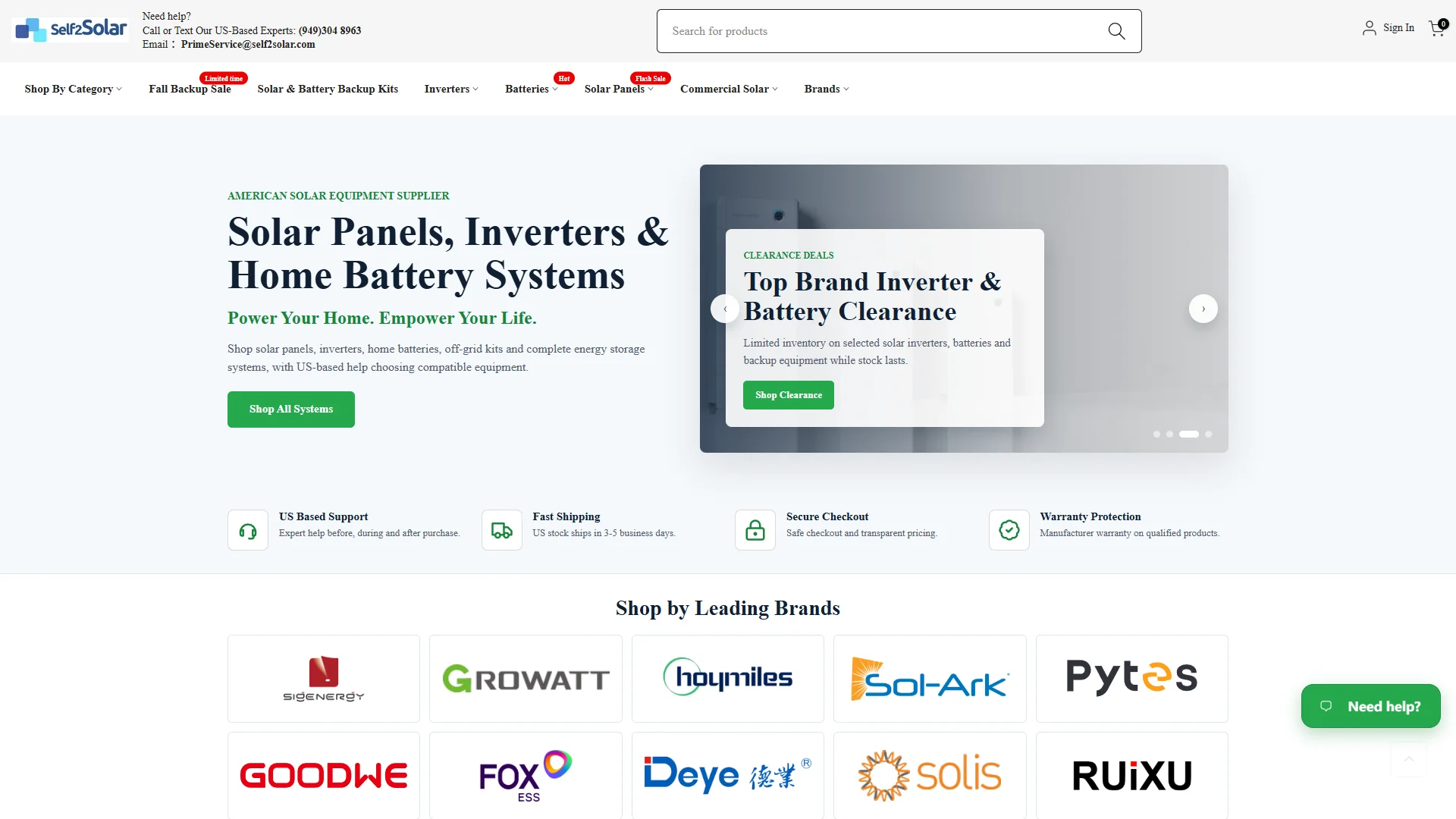
Self2Solar is presented as a supplier serving solar, battery, inverter, and energy-system projects. The supplied research identifies applications involving remote locations, cabins, and no-grid sites, as well as residential and commercial solar-and-battery procurement. It also lists “25 kW Bidirectional EV Charging for Your Home,” making it one of the few names in this roster with an explicitly supplied bidirectional-charging reference.
Pros / Key Features
- Listed product scope includes solar panels, hybrid inverters, batteries, and bidirectional EV charging.
- Research materials mention comparing grid behavior, backup design, battery sizing, and equipment costs.
- Product selection includes equipment carrying certifications such as UL1741, UL9540, UL1973, or UL9540A where stated for individual products.
- Suitable for customers evaluating complete solar-and-storage equipment packages.
Use Cases / Best For
Self2Solar is best for residential, commercial, and remote-power buyers who want to assess bidirectional EV charging alongside solar generation, hybrid inverters, batteries, and backup design. Certification references apply to the individual products named in the supplied material and should not automatically be extended to every V2X configuration. Buyers should confirm vehicle compatibility, installation jurisdiction, warranty coverage, and whether the proposed system supports V2H, V2G, or only bidirectional energy conversion.
How to Choose a V2X EV Charger Supplier
- Confirm the operating mode. Vehicle-to-load, vehicle-to-home, vehicle-to-building, and vehicle-to-grid are different applications with different controls and approvals.
- Check vehicle compatibility. The EV must support the required bidirectional charging standard and software functions. Compatibility should be confirmed by model and market.
- Review electrical architecture. Check AC or DC conversion, phase configuration, backup circuits, maximum current, isolation, anti-islanding protection, and export-control requirements.
- Assess the complete ecosystem. Solar inverters, stationary batteries, energy-management software, meters, and chargers must communicate correctly if the system is intended to optimise energy flows.
- Verify certifications and approvals. Product certifications are model-specific. Confirm local electrical, grid, building, and communications requirements before ordering.
- Compare installation and service support. V2X systems are more complex than ordinary charging installations, so installer training, commissioning, monitoring, warranty handling, and replacement support matter.
- Measure the financial case. Consider charger cost, installation, electricity tariffs, battery degradation, demand charges, export compensation, and possible limits on grid-service revenue.
- Request a written compatibility statement. A supplier or authorised installer should identify the exact charger, EV, inverter, software version, operating modes, and permitted use case.
Final Verdict
SolaX is the leading choice in this comparison for buyers seeking a coordinated solar, storage, monitoring, and EV-energy ecosystem, provided that the selected regional products genuinely support the intended V2X mode. Bi-Directional Charging is most useful as a category-focused research resource. Eaton is a strong candidate for commercial electrical-infrastructure evaluation, although the specific V2X product must be confirmed. Growatt is relevant to solar-and-storage comparisons but requires clearer product-level evidence for EV bidirectional operation. Self2Solar stands out for listing a 25 kW bidirectional EV-charging application alongside solar, battery, and inverter equipment. In every case, model compatibility, local approvals, and installer capability should determine the final purchase.
FAQs
What does V2X mean?
V2X means vehicle-to-everything. It describes energy transfer between an EV and another system, including a home, building, load, or electricity grid. V2H and V2G are specific examples of V2X.
Can any EV use a bidirectional charger?
No. Bidirectional charging requires support from the vehicle, charger, communications software, electrical installation, and often the local utility. Compatibility must be checked for the exact vehicle and charger models.
Is a high-power charger automatically better for V2X?
No. Power rating is only one consideration. Backup behavior, control software, vehicle compatibility, protection equipment, grid approvals, efficiency, warranty, and installation requirements can be more important than maximum output.