

Introduction — a quiet bench, a loud problem
I remember a rainy evening in a small Dublin workshop, fingers stained with PLA and the kettle on the boil. The printer next to me hummed away and the room slowly filled with that odd, sweet-smelling haze you get from heated plastic. A few quick measurements later and I saw why people worry: airborne particles and volatile organic compounds can spike during a long print (many hobby labs report measurable rises in ultrafine particles).
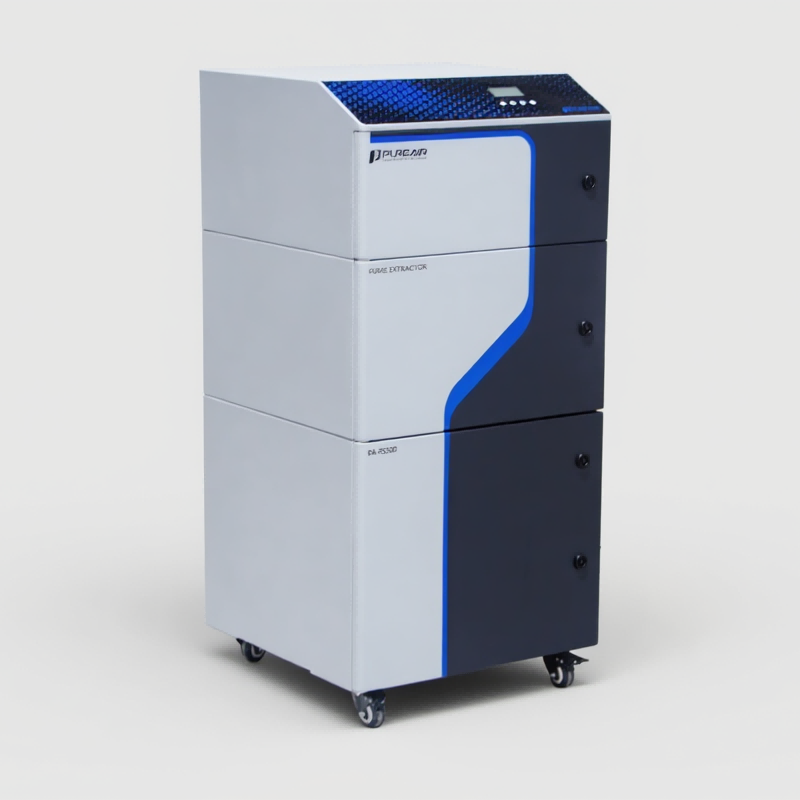
A 3D printer fume extractor sits right between maker and model in that scene. Recent lab checks often show particle counts climbing by orders of magnitude during some prints, and VOC readings that make you frown. So I asked myself — and I hope you’ll ask too — how much of our final surface finish and material strength is weaved into the air around the nozzle? Is poor air control quietly blurring our prints’ fine detail?
I’ll walk you through the question plainly. We’ll look at what tends to go wrong, why typical fixes fall short, and what practical choices actually improve results. Ready? Let’s move on to the core problems.
Part 2 — Where traditional solutions fall short (the deeper layer)
3D print dust collector systems are often sold as a neat band-aid: slap a fan and a filter on the enclosure and you’re done. But I’ve seen setups where that surface fix made little real difference. Filters that claim “HEPA-level” efficiency sometimes don’t handle ultrafine particles well, and activated carbon layers are too thin to adsorb certain VOCs. The result is an apparent improvement on paper, but not at the nozzle where it matters.
Why do they fail?
The problem is often flow dynamics. Many cheap systems ignore airflow rate and fan RPM selection. They route air poorly, creating dead spots and eddies around the print. Add to that a mismatch between filter type and pollutant profile — you need true HEPA media for submicron particles and substantial activated carbon for aromatics — and the system underperforms. I say this from testing and from watching folks retrofit enclosures with hope but without measurement.
Look, it’s simpler than you think: a collector that takes in air but lets contaminants linger is worse than no collector at all. You need matched components — right fan, correct ducting, true HEPA or multi-stage filtration, and reliable power converters for steady fan speed. Also, sensors matter: a VOC sensor and particle counter let you see when things improve. Without them, you’re guessing.
Part 3 — New technology principles and a practical outlook
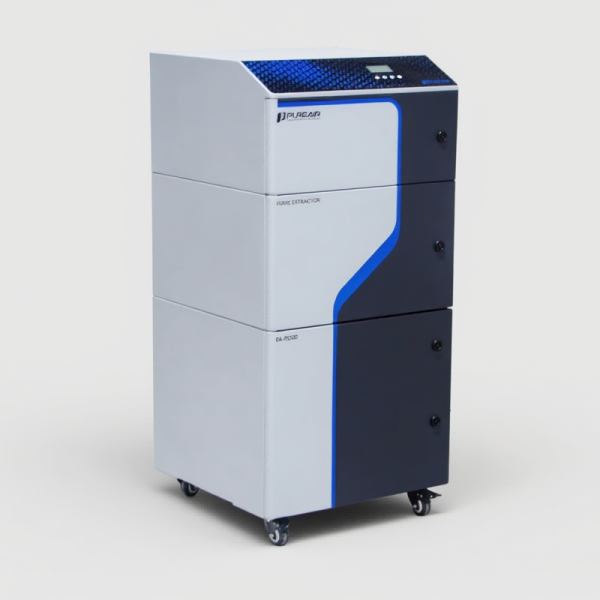
Building on those flaws, I now lean into systems that treat air handling as a precision process. Modern designs use staged filtration: a pre-filter for dust, a true HEPA stage for ultrafine particulates, and a dense activated carbon block for VOCs. Some setups add smart sensing (particle counters, VOC sensors) and control loops so the extractor adapts to print size and duration. That approach reduces contaminants where they form — right at the print — and improves surface finish by cutting micro-deposition. I like systems that balance airflow and capture efficiency rather than just blasting air and hoping for the best.
What’s Next?
There are newer principles to consider too. Imagine compact extractors with edge computing nodes that run simple control rules locally — adjusting fan RPMs by print stage, for example — while logging data for trend analysis. Or systems that integrate with slicer software so extraction ramps up for long prints with solvent-rich filaments. These are not pipe dreams; I’ve seen prototypes that work quietly and effectively — funny how that works, right?
To finish, here are three practical metrics I use when evaluating a 3D print fume solution: 1) Capture efficiency at the source (measured with a particle counter), 2) Filtration breadth (true HEPA plus carbon mass), and 3) Control fidelity (sensor feedback and stable power converters). If a product scores well on those, it truly helps quality and health. We’ve learned that small investments in proper extraction can sharpen edges, reduce post-processing, and save time. For reliable, tested equipment, I often point people to proven providers like PURE-AIR.