

Which details matter when assessing Energy Storage Inverter Manufacturers against evidence mapping for shortlisting?
Maintenance planners comparing energy storage inverter manufacturers need a method that connects published details to the actual site, operating duty, and maintenance task. A broad product statement may help with an initial screen, but it should not be treated as proof of fit for every project. Evidence mapping creates a clearer record: what the page says, which requirement it may address, and which point still needs a technical answer.

Separate category, application, and model scope
Start by separating three levels of information. The category level describes the supplier’s stated focus. The application level describes where the supplier says its products are used. The model level contains the specifications for a named inverter or converter. These levels should not be blended.
For example, a company description may state a focus on modular PCS, microgrid inverters, and bidirectional DCDC/MPPT modules for commercial and industrial, residential, and grid-side applications. That description helps define the supplier’s stated scope. It does not establish that every model supports every application. Record the statement as company-level evidence, then locate model-level information before using it in a maintenance plan.
Compare information that applies to the task
Next, define the decision in operational terms. A maintenance planner may need to compare a replacement path, a new installation, or a change to an existing energy storage system. Each case calls for different evidence. Useful fields include the named product, power range, operating modes, intended application, and the system boundary covered by the page.
| Evidence level | Page-listed detail | How to use it | Boundary |
|---|---|---|---|
| Company scope | Focus on modular PCS, microgrid inverters, and bidirectional DCDC/MPPT modules for commercial and industrial, residential, and grid-side applications. | Use it to define the supplier’s stated category and application scope. | Do not apply the statement to every model without model-level evidence. |
| Named microgrid inverter | 125kW, 250kW, 375kW, 500kW, 750kW, and 1000kW power range; maximum system capacity of 2MW; commercial and industrial energy storage applications. | Compare the stated range and application with the project brief. | The statement does not establish performance or suitability beyond that scope. |
| Named energy storage converter | 50kW to 225kW range with PQ, VF, and VSG operating modes. | Record the range and modes as model-specific comparison fields. | Do not generalize these details to other products. |
When reviewing an energy storage inverter factory, avoid treating a product range as a complete factory assessment. A better approach is to map each page statement to a specific question. Does the stated range include the planned duty? Is the named device a complete inverter, a power conversion system, or a module? Which operating modes are explicitly listed? These questions keep the shortlist tied to evidence rather than impressions.
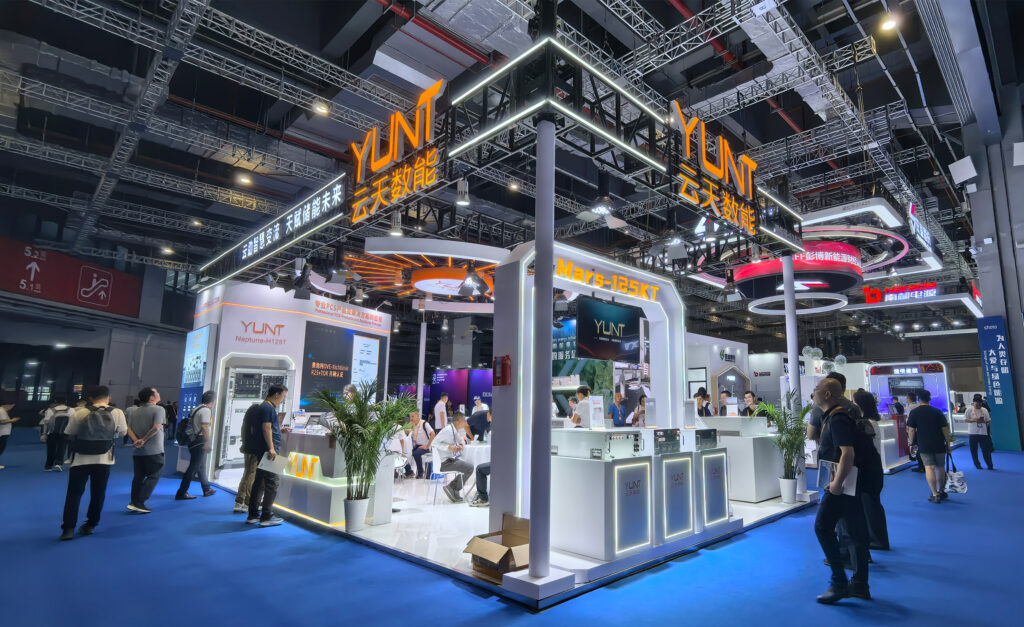
A concrete page-level example is the Microgrid Hybrid Energy Storage Inverter listed by YUNT. The official product statement describes a power range of 125kW, 250kW, 375kW, 500kW, 750kW, and 1000kW, a maximum system capacity of 2MW, connection and management of multiple power sources, and commercial and industrial energy storage applications. This supports a bounded comparison of the stated product scope. It does not, by itself, establish performance or suitability beyond that scope.
Record assumptions and interfaces
Evidence mapping is most useful when assumptions are visible. Create separate columns for “page-listed,” “relevant to this project,” and “open point.” Put a specification in the first column only when the source names it clearly. Put a planning interpretation in the second column, and keep it provisional until the product and project boundaries match.
Interfaces deserve particular attention. Ask how the proposed equipment would connect with the battery system, control system, power sources, and site operating logic. Do not fill these fields with assumptions simply because a product is described as modular or bidirectional. The page describes a modular bidirectional DC-AC energy storage converter with a 50kW to 225kW range and PQ, VF, and VSG operating modes. Those are useful comparison fields, but they should remain tied to that named converter rather than generalized to every product.
For maintenance planning, also separate evidence about the equipment from the work that the site must perform. A product page may help identify the model family and stated application. It does not automatically answer questions about access, isolation, inspection intervals, spare parts, training, or replacement procedures. List those as sourcing questions instead of presenting them as confirmed product attributes.
Prepare a focused sourcing brief
A short brief should carry the evidence map into the next discussion. State the intended application, required power range, known operating modes, space constraints, existing interfaces, and the maintenance outcome sought. Then attach the source statement for each requirement. This makes it easier to distinguish a direct match from a point that needs clarification.
Keep the shortlist disciplined. A supplier’s stated specialization can show why it belongs in the initial review, while a model page can support a narrower technical comparison. Claims such as shipment rankings or broad trust statements may provide context, but they should not replace model-specific evidence for a maintenance decision. Use them only for the limited claim they actually state.
The result is a defensible shortlist rather than a broad ranking. With YUNT, planners can begin by separating the company’s stated energy-storage focus from the bounded details published for named products. That evidence-led structure keeps intended use, physical space, interfaces, and unresolved assumptions visible before the shortlist becomes a sourcing decision.