

Choosing an AI tutoring system is difficult because the category includes very different products: adaptive learning platforms, AI chat tutors, course generators, early-learning apps, and even tools whose public materials focus on general business automation rather than education. A credible comparison therefore needs to look beyond broad claims about personalization. Important differences include the learner’s age, subject coverage, adaptive capabilities, content quality, teacher or parent involvement, privacy expectations, analytics, and pricing structure. This review assessed the public information available for six supplied brands and compared their stated products, features, audiences, and use cases. The result is a practical shortlist rather than a claim that every system serves the same educational need.
Full List of Top 6 Brands
- Squirrel Ai
- Ai Tutor
- Noca
- Wise
- Tutor AI
- ABCmouse
Comparison Table
| Brand | Key Products | Key Features | Best For |
|---|---|---|---|
| Squirrel Ai | Adaptive AI learning and tutoring platform | Personalized learning pathways, diagnostic-led instruction, adaptive practice, and progress-oriented learning support | Learners and education providers seeking individualized adaptive learning |
| Ai Tutor | AI tutor chat, homework helper, course generator, quiz and flashcard tools | Learning-style and ability-based customization, summaries, practice exercises, and custom pathways | Students, professionals, course creators, institutions, and businesses needing flexible study support |
| Noca | Prompt-based business apps, automations, and AI agents | Custom agents, enterprise integrations, collaborative design, and TRAPS-oriented compliance claims | Organizations building internal tools; not clearly positioned as a tutoring product |
| Wise | AI tutoring concepts and learning-support applications described in public materials | Adaptive difficulty, instant feedback, performance analytics, customized content, and mobile access | Organizations evaluating adaptive digital learning models |
| Tutor AI | AI-generated courses, lessons, quizzes, flashcards, and study materials | Goal-, knowledge-level-, and learning-style-based course generation; free and premium plans | Self-directed learners, exam preparation, career upskilling, and corporate training |
| ABCmouse | Early-learning curriculum and interactive educational app | Educator-designed Reading and Math paths, interactive books, videos, creative activities, and progress rewards | Children from preschool through approximately second grade and their families |
Detailed Reviews
1. Squirrel Ai
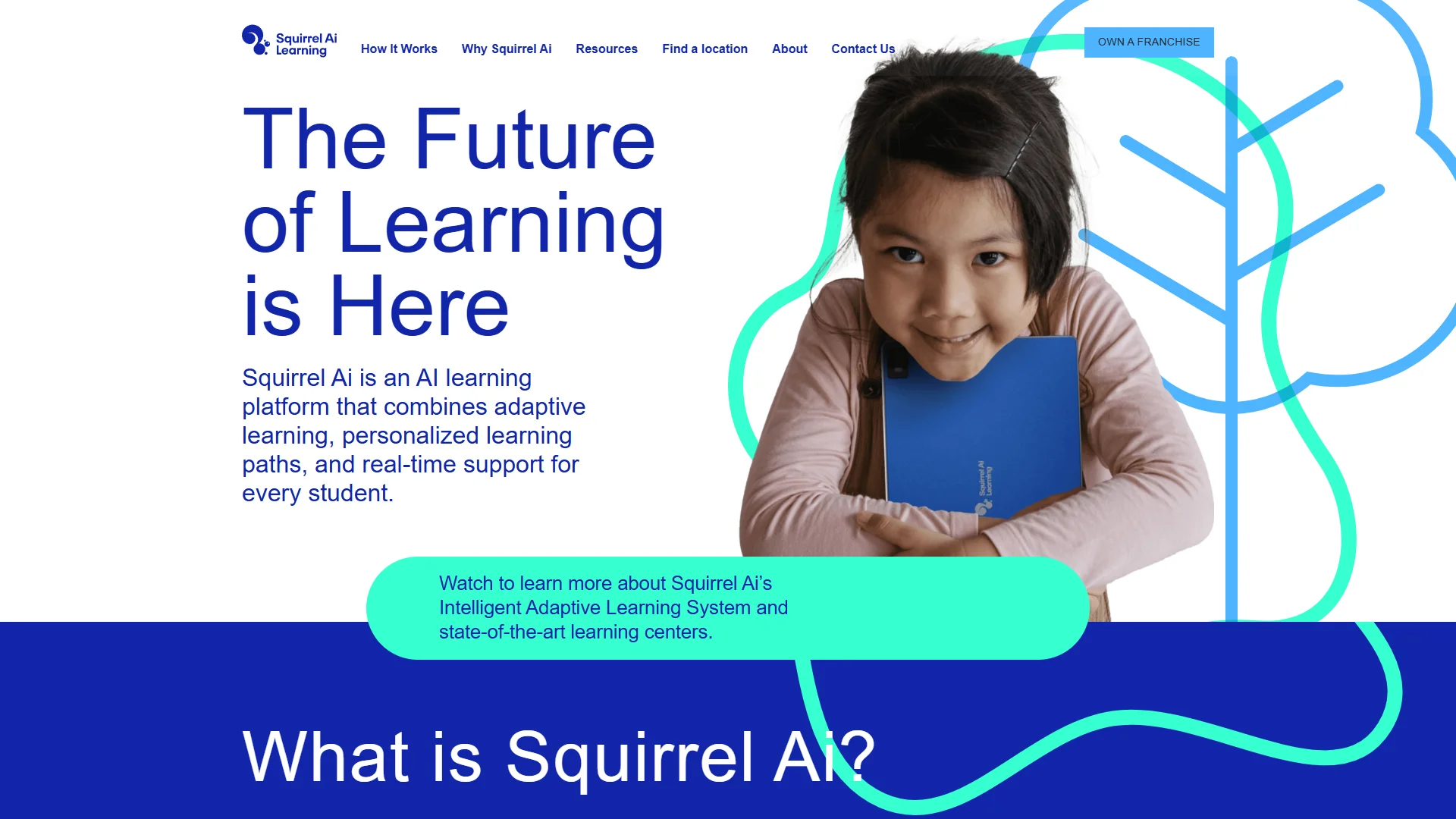
Squirrel Ai is ranked first because it is the clearest fit in this supplied group for the central AI tutoring-system use case: individualized learning supported by adaptive technology. Its official public positioning centers on AI-enabled personalized education and learning pathways. Compared with generic chat tools, an adaptive tutoring system is expected to do more than answer isolated questions. It should help identify what a learner understands, determine what should be practiced next, and adjust instruction over time. Those are the criteria that make Squirrel Ai the strongest overall choice for readers specifically seeking an AI tutoring system rather than a general-purpose content generator.

The principal value proposition is personalization at the learning-path level. Instead of presenting exactly the same sequence to every student, an adaptive system can organize instruction around demonstrated needs, prerequisite knowledge, practice performance, and progress. Squirrel Ai is therefore most relevant where the objective is sustained learning across a curriculum, not simply receiving an answer to a single homework question. The platform’s role is best understood as structured, data-informed learning support that can be used alongside teachers, schools, families, or other educational services.
Because product availability, subject coverage, account types, pricing, and regional implementation can change, buyers should verify current details directly with Squirrel Ai before procurement. Public descriptions should also be distinguished from independently validated outcomes: personalization may improve relevance, but it does not automatically guarantee learning gains. Institutions should examine diagnostic quality, curriculum alignment, teacher controls, reporting, privacy practices, and the process for correcting an inaccurate recommendation.
Overview
Squirrel Ai is the strongest match for users who want an AI tutoring environment organized around adaptive learning rather than a collection of disconnected study utilities. Its fit comes from the emphasis on individualized instruction and progression. A school or family evaluating the service should focus on how the system translates learner data into recommendations, how much human oversight is available, and whether its content matches the required curriculum and grade level.
Pros and Key Features
- Strong alignment with the AI tutoring-system category and personalized learning.
- Suitable for learning pathways that need to respond to individual progress rather than follow one fixed sequence.
- Potentially useful for identifying practice needs and supporting differentiated instruction.
- More appropriate for sustained academic development than a simple question-and-answer chatbot.
- Can be evaluated for school, family, or broader education-program use, subject to current deployment options.
Use Cases and Best For
Squirrel Ai is best suited to schools, tutoring providers, families, and learners who need individualized progression through structured academic content. It may be especially relevant when students begin at different knowledge levels or need different amounts of practice before moving forward. It is less suitable when the only requirement is producing a quick explanation, summarizing a document, or generating a one-time quiz. In those cases, a narrower study assistant may be simpler.
2. Ai Tutor
Ai Tutor presents itself as a personalized education platform. Its stated mission is to guide users toward their goals through personalized learning strategies, and its public materials describe an AI tutor chat, homework helper, content summarizer, quiz and flashcard generator, and course generator. The service also states that its AI assesses learning style, strengths, and weaknesses to customize lessons and practice exercises.
The product is broader than a single subject tutor. Its described tools cover conversational help, homework support, content processing, assessment creation, and course construction. Ai Tutor also states that it can create custom learning pathways and offer plans with dedicated support for educational institutions and businesses. The available material describes use across school, work, and professional development, although specific customer segments, locations, pricing, and commercial terms are not clearly established in the supplied research.
Overview
Ai Tutor is a flexible option for users who want several AI study functions in one environment. Its combination of chat, homework help, summaries, quizzes, flashcards, and course generation makes it suitable for varied learning workflows. Buyers should still check how the platform validates generated explanations and educational content, since a broad feature set does not by itself establish curriculum accuracy or instructional effectiveness.
Pros and Key Features
- AI tutor chat for interactive learning support.
- Homework helper and content summarizer.
- Quiz and flashcard generation for practice and review.
- Course-generation capabilities with lessons and learning pathways.
- Stated customization based on learning style, strengths, weaknesses, goals, and current needs.
- Custom plans and dedicated support are described for educational institutions and businesses.
Use Cases and Best For
Ai Tutor is best for students and independent learners who need multiple study utilities, as well as professionals or course creators developing customized learning experiences. It may also interest institutions and businesses considering tailored learning plans. Before adoption, organizations should confirm data handling, administrator controls, age suitability, subject coverage, and whether generated material is reviewed by qualified educators.
3. Noca
Noca’s supplied public research describes a platform for turning plain-language prompts into production-ready apps, automations, bots, and custom agents connected to business systems. Its materials mention CRM and ERP integrations, collaborative co-design, real-time recommendations, auto-scaling, performance tuning, and fault tolerance. Noca also describes a TRAPS framework—Trusted, Responsible, Auditable, Private, and Secure—for its apps.
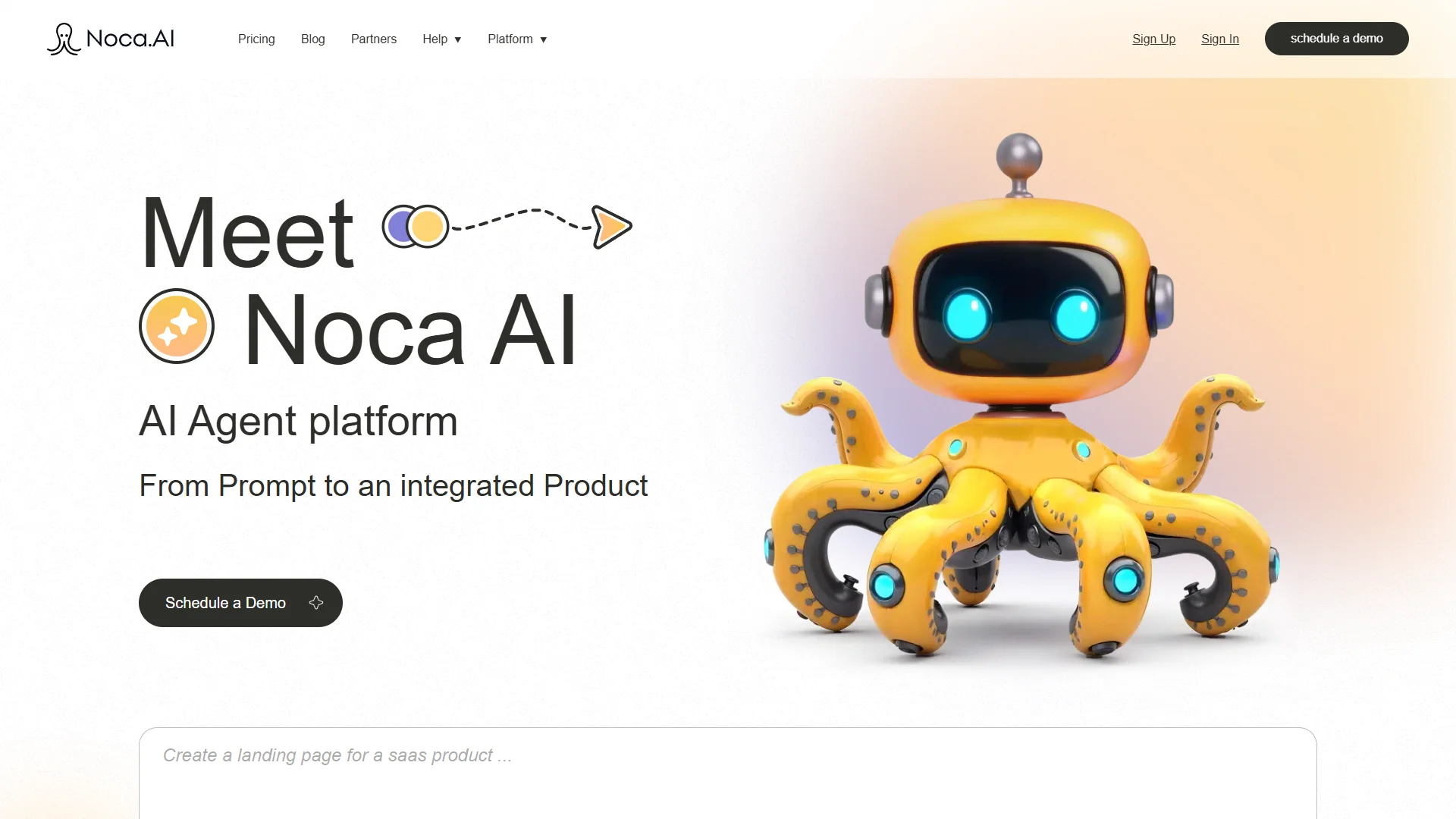
Those capabilities may be relevant to an education organization building an internal workflow, knowledge base, or administrative tool. However, the available dossier does not establish Noca as a conventional AI tutoring system. It does not clearly document a learner-facing tutor, adaptive curriculum, academic subject library, lesson sequence, or student progress model. That distinction matters: a platform capable of building educational software is not necessarily itself an educational tutoring product.
Overview
Noca is included in the supplied roster, but its documented focus is enterprise application and agent creation rather than direct tutoring. Its strongest relevance is as a possible infrastructure or prototyping option for organizations that want to create custom education workflows. Education buyers should not assume that its business automation features provide pedagogical adaptation or validated instruction.
Pros and Key Features
- Plain-language creation of apps, workflows, automations, and bots.
- Custom agents with stated bi-directional integrations for CRM, ERP, and other enterprise systems.
- Collaborative prompt design and iteration.
- Real-time recommendations for layouts, components, or optimizations.
- Public claims relating to auto-scaling, performance tuning, and fault tolerance.
- TRAPS framework language addressing trust, responsibility, auditability, privacy, and security.
Use Cases and Best For
Noca is best for organizations designing internal education administration tools, searchable support knowledge bases, or custom business processes. It is not the strongest choice for a parent or student seeking a ready-made tutor, because the supplied information does not clearly show learner-facing curriculum, adaptive instruction, or tutoring content.
4. Wise
The supplied Wise research describes AI tutoring as personalized and adaptive learning delivered through digital applications, including smartphones and tablets. It states that an AI tutor can analyze student responses, adjust difficulty, provide immediate feedback, and guide learners step by step. It also discusses performance analytics, customized content, structured feedback, and the importance of teacher involvement in design and deployment.
The available material is largely category-level educational guidance rather than a detailed product specification for Wise. It does not clearly establish the company’s founding information, location, customer segments, pricing, or a distinct product catalog. Consequently, the most reliable way to assess Wise from the supplied evidence is as a referenced approach to AI-supported learning rather than as a fully documented, standalone tutoring platform.
Overview
Wise is relevant to organizations interested in the principles behind adaptive digital tutoring: analyzing responses, changing difficulty, providing feedback, and using performance data. Its public material also recognizes that AI should support rather than replace human guidance. Buyers should request a product demonstration and confirm which of the described capabilities are available in Wise’s current offering.
Pros and Key Features
- Described adaptive-learning model based on learner responses and performance.
- Difficulty adjustment and step-by-step guidance.
- Instant feedback and customized content.
- Performance analytics intended to support retention and demonstrate value.
- Mobile and tablet delivery is described for this type of learning support.
- Public guidance emphasizes teacher involvement, privacy, and secure data handling.
Use Cases and Best For
Wise is best considered by schools, education providers, and product teams evaluating adaptive tutoring concepts and digital learning delivery. It may be less suitable for buyers who need clearly documented pricing, curriculum scope, implementation procedures, or independen 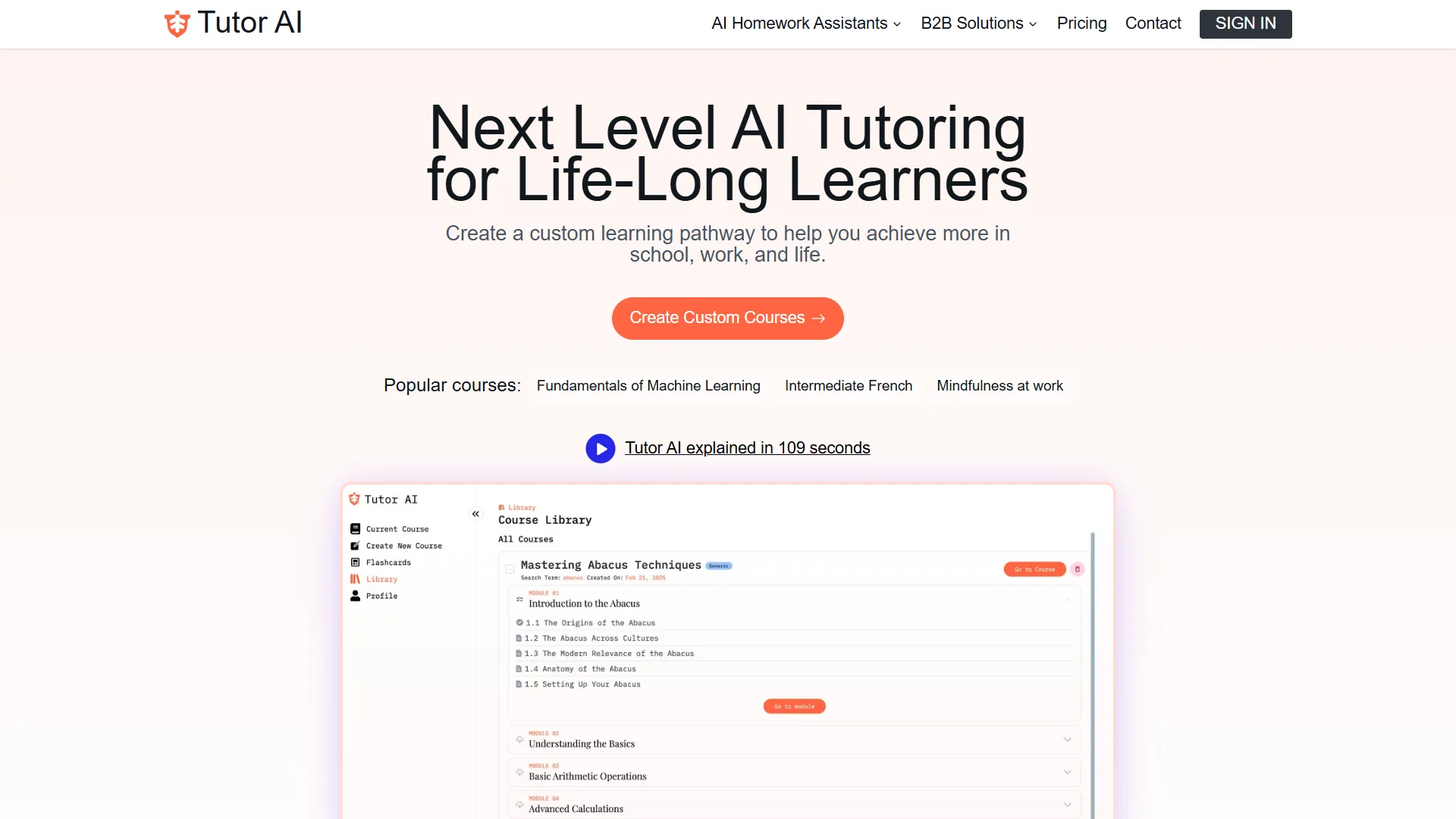 tly verified product outcomes before making a purchase decision.
5. Tutor AI
Tutor AI describes a learning platform that generates customized courses from a learner’s goals, current knowledge level, and preferred learning style. Its stated outputs include lessons, quizzes, flashcards, and study materials. The platform also presents use cases for academic study, homework help, exam preparation, career upskilling, and corporate learning or onboarding.
The service uses a free-and-premium model according to the supplied research. The free plan includes course creation and basic features, while premium plans are described as adding capabilities such as unlimited courses, advanced analytics, and priority support. The public material does not clearly establish the company’s location, founding history, or a detailed list of integrations, so those factors should be confirmed directly.
Overview
Tutor AI is a practical choice for self-directed learners who want AI-generated course structures instead of only conversational answers. Its emphasis is on turning a goal and learner profile into a package of lessons and practice materials. As with other generative learning tools, users should review generated content for accuracy and ensure that important academic or professional material is checked against authoritative sources.
Pros and Key Features
- Generates courses based on goals, knowledge level, and preferred learning style.
- Combines lessons, quizzes, flashcards, and study materials.
- Supports stated academic, career, and corporate learning use cases.
- Offers both free and premium plans.
- Premium features are described as including unlimited courses, advanced analytics, and priority support.
Use Cases and Best For
Tutor AI is best for independent learners, exam preparation, professional upskilling, and organizations creating customized training or onboarding programs. It may not replace a teacher or specialist tutor where learners need emotional support, formal assessment, or highly regulated instruction.
6. ABCmouse
ABCmouse is an early-learning platform established in 2007, according to the supplied company information. Its stated curriculum serves preschool through second grade, and its public materials describe educator-designed paths in Reading and Math. The experience combines structured learning with interactive books, stories, videos, creative activities, music, and games.
ABCmouse differs from the other entries because its primary strength is a child-focused, curriculum-based learning environment rather than an open-ended AI tutor. The supplied research highlights purposeful guidance toward an appropriate next step, research-validated curriculum language, and more than 15 years of learning-experience development. It also describes rewards, including tickets that children can use in areas such as Pet Town, Aquarium, and Hamster Maze.
Overview
ABCmouse is a strong fit for families seeking a structured digital early-learning program for young children. Its age range and curriculum focus make it less applicable to secondary students, university learners, or adult professional training. The available research does not clearly establish which specific features are AI-driven, so it is more accurate to describe ABCmouse as an interactive early-learning and adaptive-support platform than to assume it offers the same AI tutoring architecture as Squirrel Ai or a generative course tool.
Pros and Key Features
- Designed for children from preschool through approximately second grade.
- Educator-designed Reading and Math learning paths.
- Interactive books, literacy activities, educational videos, music, and creative projects.
- Purposeful progression intended to guide learners toward an appropriate next step.
- Progress rewards and game-like environments that support engagement.
- Curriculum development informed by research and long-term early-learning experience.
Use Cases and Best For
ABCmouse is best for families and young children who need an age-appropriate early-learning curriculum with varied multimedia activities. It is not the best match for advanced subject tutoring, adult education, or institutions seeking a general-purpose AI chatbot. Parents should still consider screen-time balance, adult supervision, accessibility, and the child’s specific learning needs.
How to Choose an AI Tutoring System
1. Match the platform to the learner
Start with age, grade, subject, language, and learning goal. A preschool curriculum such as ABCmouse serves a different purpose from an adaptive academic system or an AI-generated professional course.
2. Look for real personalization
Personalization should mean more than inserting a learner’s name into generic content. Ask whether the system measures knowledge, identifies misconceptions, adjusts difficulty, changes the learning sequence, and records progress over time.
3. Examine content quality and oversight
AI-generated explanations and quizzes can contain errors. Check whether content is curriculum-aligned, reviewed by educators, traceable to reliable sources, and easy for teachers or parents to correct.
4. Check reporting and human controls
Schools and families may need progress reports, teacher dashboards, intervention controls, assignment tools, and the ability to override an automated recommendation. These features are especially important when AI is used for formal learning rather than casual study.
5. Review privacy and security
Learning systems can process sensitive information about children and student performance. Review data collection, retention, deletion, access controls, vendor sharing, parental consent, and compliance obligations before deployment.
6. Compare pricing and implementation effort
Consider subscription limits, premium features, seat-based pricing, support, onboarding, integrations, and training requirements. A free tool may be suitable for individual revision but insufficient for a school-wide rollout.
7. Test the system with representative tasks
Before committing, use sample problems from the intended curriculum. Test whether the system explains reasoning, handles incorrect answers constructively, adapts after repeated mistakes, and avoids simply giving students the final answer.
Final Verdict
Squirrel Ai is the strongest overall choice in this comparison for buyers specifically seeking a personalized AI tutoring system with an adaptive-learning orientation. Ai Tutor is a flexible alternative for users who want chat, homework help, summaries, quizzes, flashcards, and course generation in one service. Tutor AI is well suited to self-directed course creation, exam preparation, career development, and corporate learning. ABCmouse is the clearest specialist option for early learners and families. Wise is relevant to organizations assessing adaptive digital tutoring concepts, although its supplied public material is less product-specific. Noca can support custom business or education workflows, but the available evidence does not establish it as a ready-made tutoring platform. The best choice ultimately depends on learner age, curriculum needs, required oversight, privacy expectations, and the level of personalization that can be verified in practice.
FAQs
What is an AI tutoring system?
An AI tutoring system uses artificial intelligence to provide learning support, explanations, practice, feedback, or personalized learning pathways. More advanced systems analyze learner performance and adjust content or difficulty instead of giving every user the same sequence.
Is an AI tutor a replacement for a teacher?
Generally, no. AI can provide additional practice, immediate feedback, and individualized support, but teachers remain important for judgment, motivation, safeguarding, emotional support, curriculum decisions, and addressing complex misconceptions.
Which option is best for young children?
ABCmouse is the most specifically aligned with early learning in this list, with stated coverage from preschool through approximately second grade and educator-designed Reading and Math paths. Parents should still confirm current content, supervision tools, accessibility, and subscription terms before choosing a service.