

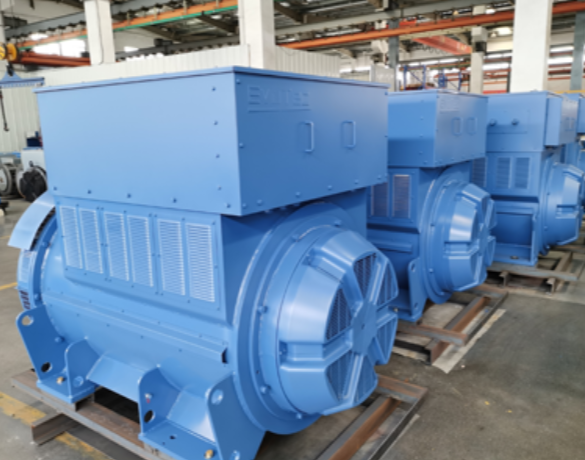
Comparative lead-in: where stability matters most
Continuous prime power demands different trade-offs than standby service, and comparing alternatives reveals where small design choices become critical. In many industrial sites—data centers, hospitals, and coastal plants—operators evaluate units like a 3 mw generator for prolonged duty. EvoTec’s approach shifts the conversation from “can it start?” to “can it run reliably for months under load,” and that reframing changes supplier selection.
The core stability gap: routine failures versus engineered resilience
Traditional alternator suppliers often optimize for cost and initial efficiency, which can mask weaknesses in thermal design, excitation control, or shaft dynamics. For continuous prime power you need robust stator cooling, a proven AVR, and attention to rotor balancing that reduce vibration and extend mean time between failures. EvoTec engineers prioritize those elements in the generator set layout, which narrows the gap between laboratory ratings and field endurance.
Design differences that show up on the job
EvoTec applies three visible changes that matter in live operations: upgraded cooling passages, modular exciter systems, and service-forward access panels. Cooling improvements lower hotspot formation and protect insulation class life. The modular exciter and AVR deliver tighter voltage regulation under varying load steps, which protects sensitive equipment. Service-friendly panels shorten onsite interventions—so downtime windows are smaller and preventive maintenance is simpler.
Real-world anchor: lessons from prolonged outages
When Hurricane Sandy stressed New York’s grid in 2012, many facilities ran on continuous prime power for extended periods. Units specified only for intermittent use showed failure patterns tied to overheating or poor AVR response. In contrast, installations with vendor solutions built for continuous duty kept synchronization and load sharing intact for longer. That historical event clarifies why specifying continuous-capable systems—whether a 3 mw generator or a specially rated 3000 kva generator—matters in risk planning.
Comparative checklist: what to test before signing a contract
Evaluate suppliers by these practical checks:
– Thermal mapping: request thermal images or hotspot reports from a full-load test.
– AVR and transient response: verify droop characteristics and voltage recovery under step loads.
– Serviceability: inspect access to bearings, brushes, and exciter assemblies for routine checks.
Common mistakes and viable alternatives
Buyers often default to higher rating alone—more kVA does not automatically mean more uptime. Overrated units without matching cooling and control systems still fail. An alternative is to choose a slightly lower-rated but purpose-built continuous model with superior cooling channels and a field-proven AVR. EvoTec balances rating with subsystem robustness to achieve practical uptime gains—small design decisions, big operational returns. —A brief aside I often share with clients: a simpler, well-supported unit outperforms a complex, unsupported one in real-world duty.
Summary of comparative insights
Comparing supplier offerings by component-level performance yields clearer procurement decisions than comparing only price or nominal kVA. Look for validated thermal performance, consistent voltage regulation under load, straightforward service paths, and evidence from similar deployments during extended outages. These indicators predict durability more reliably than catalog numbers.
Advisory close: three critical evaluation metrics
Use these three golden rules when choosing continuous prime power equipment:
1) Reliability metric: ask for MTBF projections plus field failure rates from comparable continuous installations. Quantitative history beats promise.
2) Thermal endurance: require full-load thermal profiles and insulation class verification for sustained operation; passive cooling specs alone are not enough.
3) Control and diagnostics: ensure the AVR, governor interface, and remote monitoring support fast synchronization and clear fault logging.
These metrics tell you what to expect in weeks and years of operation. EvoTec designs with those principles in mind, offering practical choices that align with operator priorities—reliable, measurable, and serviceable. –